

May 2026
Spain, Aurèlia Muñoz, textile gatherings & links

In this newsletter you’ll find:
Studio Views in Spain
Aurèlia Muñoz at the Reina Sophia
Look & Listen
Studio Views in Spain
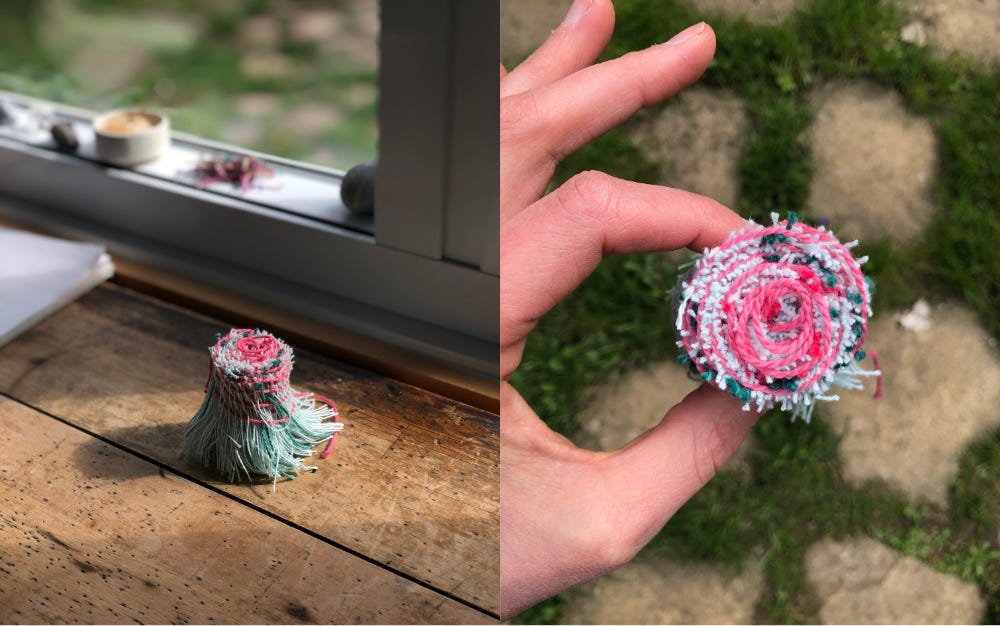
In May I had the privilege of a vacation to Spain (I went somewhere and it wasn’t for work!). I still managed to make it somewhat about work because we met some interesting craftspeople and lucked out with several excellent exhibitions along our route. Since the studio work I’m doing right now is very much in-progress, and I am in need of a creative rest/reset, I’m going to share some of these new connections instead — plus a few other interesting textile things I’ve come across in Look & Listen.
Aurèlia Muñoz at the Reina Sophia
I normally think I’m a fairly organized person but something about this winter had me working at the last minute for every single thing, so we left for Spain without much of a plan.
A week before we arrived in Madrid, I decided that maybe yes, perhaps we should go to at least one museum, and this is when I learned about Aurèlia Muñoz’s exhibition, Beings, at the Museo Nacional Centro de Arte Reina Sophia.
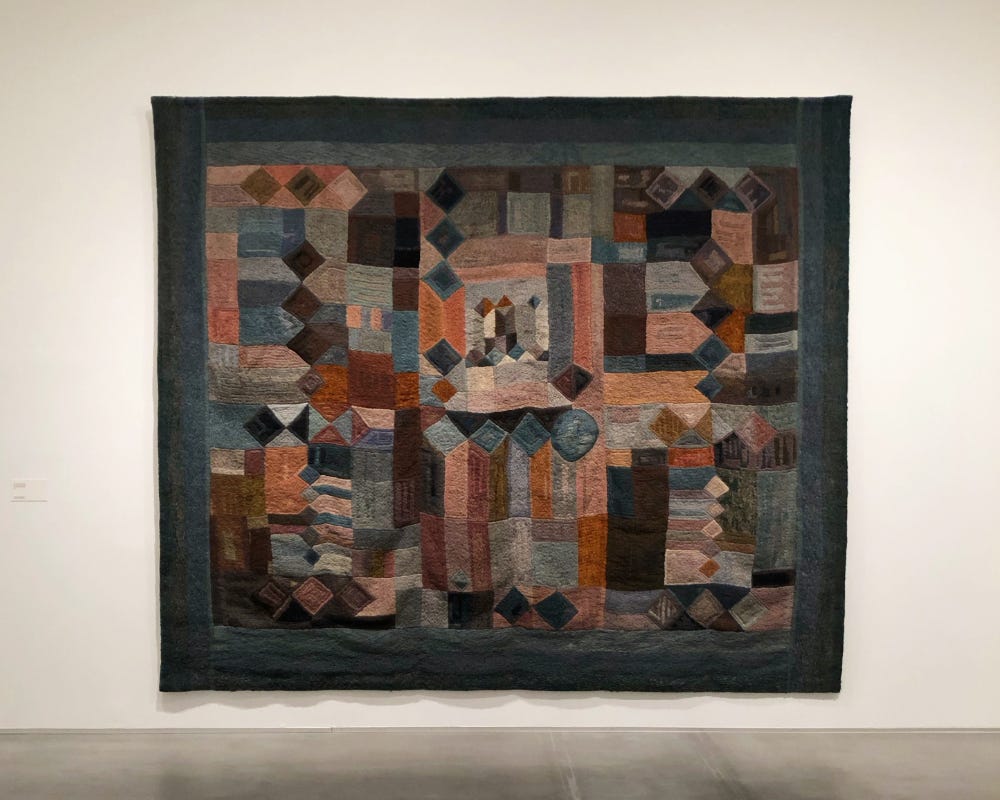
Muñoz was a Spanish textile artist who made the decision to devote herself to art in the 1950s when she was already in her 30s. Beings charts her work through the next 50 years of her practice, introducing the viewer to sculptures made from thread and paper, embroidered tapestries, macrame, preparatory drawings and maquettes; many of these pieces have never been exhibited before and much comes from her archives. This year marks a centenary since her birth, and Beings is one of many events celebrating her life and work.
I didn’t really know much about her her, perhaps only that she made large macrame sculptures in a similar vein to Magdalena Abakanowicz. I appreciate this style of work but it’s not really my favourite, so it was a delight to wander through the rooms and experience more than just the titular Beings; Muñoz’s considered and deeply creative practice felt so clear and personal, embodied across techniques and materials with a refreshing authenticity.
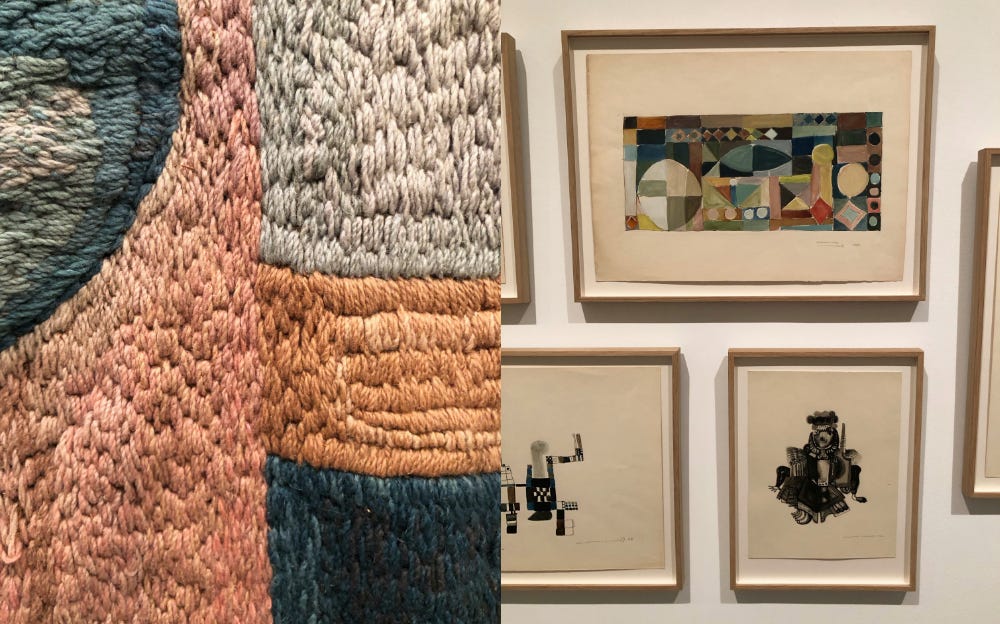
In the first gallery you encounter embroidered tapestries. Stitched onto hessian sacks, these densely worked surfaces are not woven, but appear as though they could be — and indeed, in 1965, they were the first time embroidery was selected for the Lausanne International Tapestry Biennial. In creating these works, Muñoz was responding to a long tradition of Spanish needlework and Catalan “needle painting,” “acu pictae”, that can be found in works such as the Tapestry of Creation in the Girona Cathedral.
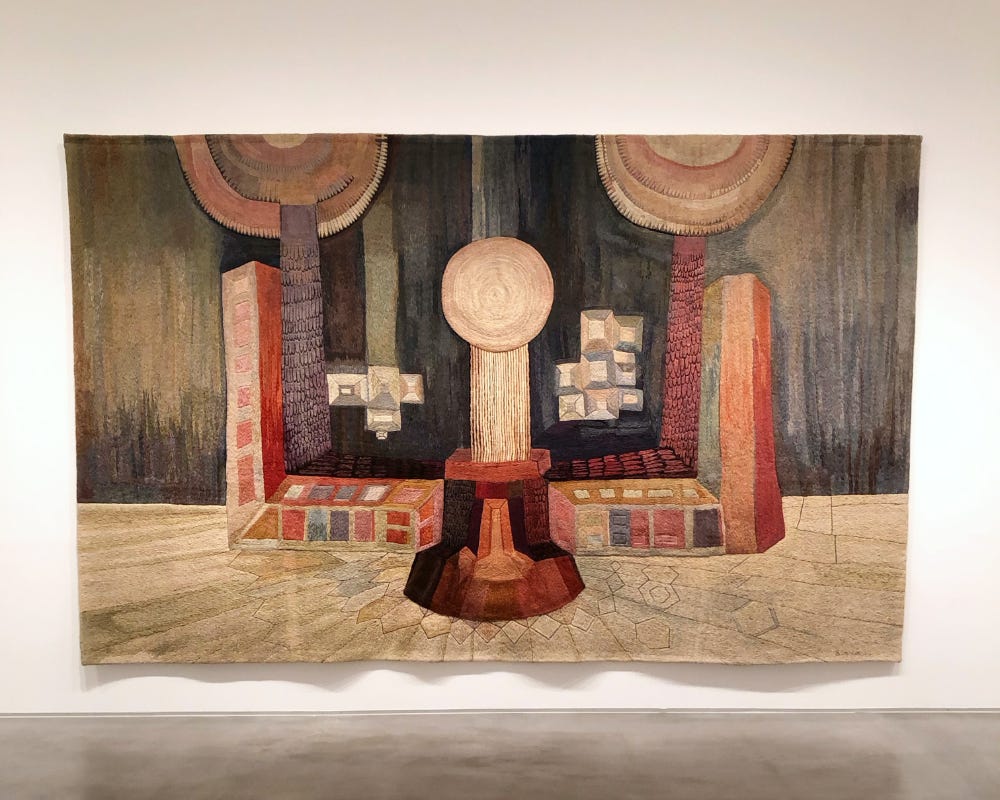
These large textile works were sometimes created in several pieces — for example, Homage to Jerónimo Bosco (Homage to Hieronymus Bosch), 1971, was constructed in pieces with the help of a team and stitched together before being delivered to the client. This is the first time it’s been on display to the public.
I am deeply fascinated by artistic process, so it was the drawings, maquettes and other preparatory work that really brought this exhibition together for me. Muñoz was deeply inspired by Surrealism, Modernisme and other Avante-Garde movements and artists like Antoni Gaudí, Paul Klee, and Joan Miró, and I felt this was evident in her pen, ink, watercolour, and gouache drawings, which featured abstract shapes, animals, birds, and other assembled figures.
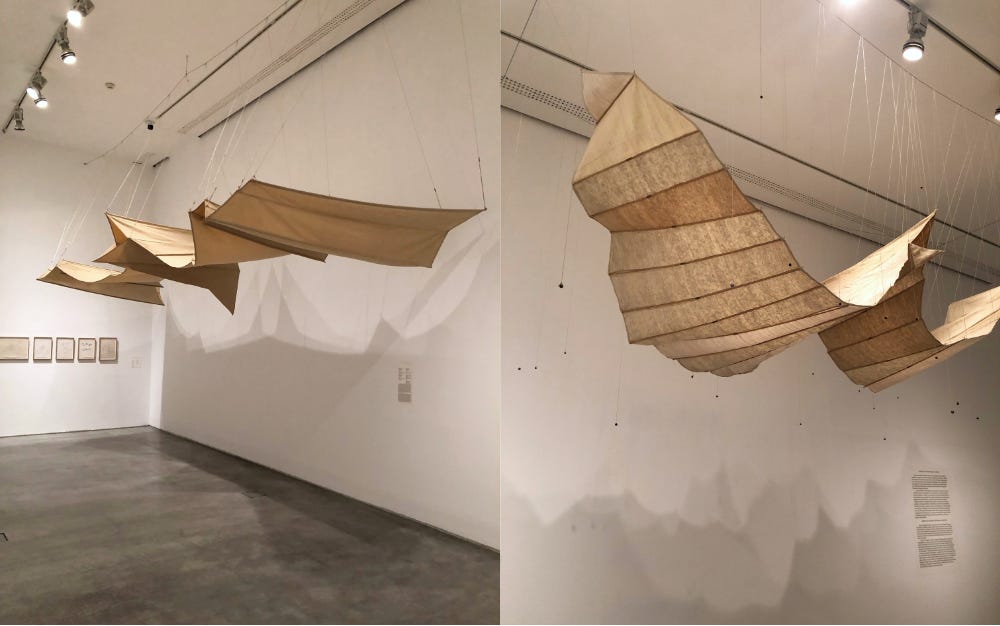
Several groups of drawings were displayed in the second gallery with the wonderful airborne Aerostat, or bird-kite, sculptures floating above. These works began in the late 1970s, inspired by early airplanes and paragliding equipment. As the title of the exhibition suggests, the Aerostats are much more than the sum of their canvas-and-rod materials; there was an aliveness and child-like personality to the pieces, like a paper airplane or origami bird come to life. They were all the richer for the maquettes (studio models) and 2d sketches presented alongside.
At this point I was already thrilled by what I was seeing and that was only two rooms! There were still four more to go! Muñoz had a very wide-ranging practice and in a retrospective like this it was very pleasing to travel from embroidered tapestry to Aerostat to drawing to macrame sculpture and see the through-line of ideas, interests, and themes. The third room featured pieces from her Aerial Books series, bringing together reading and flight, two of Muñoz’s lifelong creative interests. For her, the book wasn’t just something that held information, but an object, or perhaps being, with a materiality of its own. Looking around, you can see the echos of this conceptual and physical exploration of books and reading scattered throughout her work.
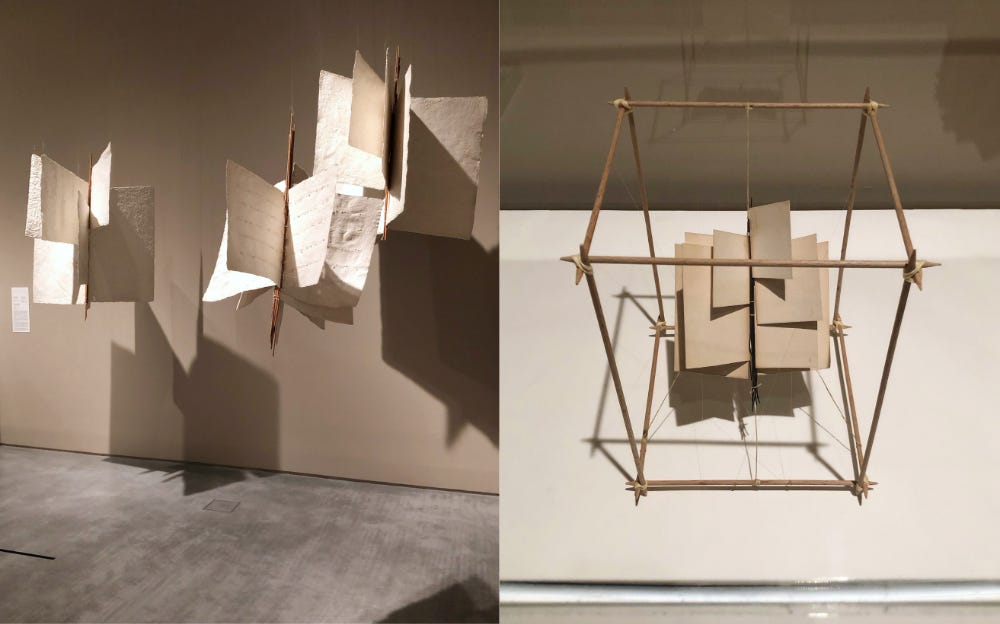
Progressing, there was a gallery full of handmade paper sculptures and another with preparatory work from her archive. In the last space were Muñoz’s Beings, large hanging macrame sculptures that she began working on in 1967 after breaking her leg; macrame knots are something she could do while remaining immobile during recovery, and these massive works mark the shift from her earlier flat stitched wallworks. These pieces are what brought her international recognition, and, as I mentioned earlier, recall other contemporary women artists of her time, like Magdalena Abakanowicz, Olga de Amaral, and Lenore Tawney.
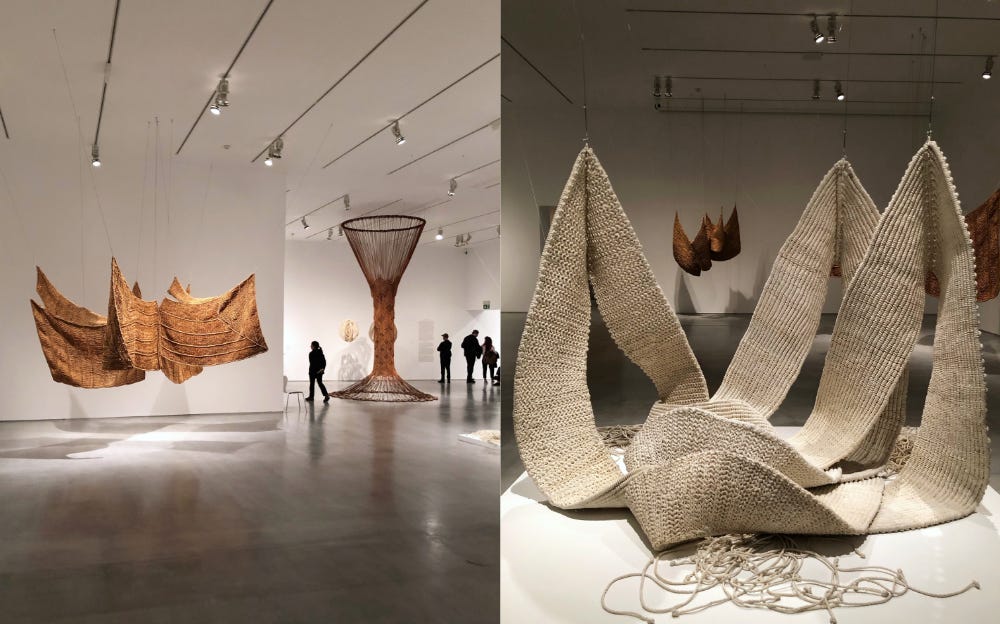
The exhibition text presents the role of the knot in Muñoz’s practice as “as an essential gesture, underlying all the artistic languages she had explored up to then,” and positions them as “simultaneously surface and volume, body and garment.” Again, like in other pieces, figures with a curious intelligence take shape as you walk around many of the works, characters arrested in the middle of movement.
You can tell when an artwork feels “dead,” a flat thing on the wall that may have beauty or interesting elements, but lacks an ineffable vitality (and I saw an exhibition like this later on — I’ll share it next month). Muñoz’s works couldn’t be further from this; even in the white cube of a huge gallery, they were alive, animated - beings - the artist’s presence and hand looking forward from the past.
Beings is on display at the Reina Sophia (which offers free admission in the evenings) until September 7, 2026, after which it travels to MACBA in Barcelona from November 5, 2026 - March 29, 2027. A full list of centenary exhibitions and events can be viewed on the MACBA website here. There is a catalogue produced about this exhibition as well; it’s a good thing the gift shop was closed, I have a bad habit of collecting heavy books while travelling…
The wall texts in the exhibition were a great help in gathering my thoughts for this newsletter, as well the information and Press Kit produced by the Reina Sophia.
Look & Listen
Ten years after the last edition, the Flax and Linen Symposium returns this summer. Held in Bedford, PA, (USA) from August 21-23, 2026, this event is both a learning and gathering opportunity for people interested in flax and linen, as well as a fundraiser for the National Museum of the American Coverlet. There are very interesting sounding presentation on topics like flax growing and processing, making flax tools, and weaving on warp-weighted looms, as well as workshops and a marketplace.
Flax is having a moment! Related to the above, this article in the Guardian from a few months ago: ‘Linen is meaningful in Belfast’: how an old industry is weaving the city a new identity.
Coming up at the end of June is the WARP (Weave a Real Peace) Annual Gathering, which is being held in Guelph, Ontario, from June 24-28, 2026. WARP is a non-profit organization with members located world-wide, and this year’s gathering brings together “Indigenous artists, regenerative fiber farmers, sustainability innovators, historians, fashion disruptors, scholars, and makers,” with programming such as a keynote address by Naomi Smith, an artist from the Chippewas of Nawash Nation in Neyaashiinimiing, a talk by Toronto-based weaver Deborah Livingston-Lowe and Wave Weir about local fashion and textiles, as well as a marketplace. Information about this conference can be found on their website here.
Bower is a free online drafting program for weavers that runs through your browser. I haven’t tried it yet, but it looks promising! There is no downloading required, no subscription, and it works on all platforms, even your phone. An advanced version is available for a small licensing fee, with additional features like block substitution, direct editing, yarn simulation, advanced rendering, and offline use. But creating, saving, and printing drafts from the free version are all free, making it a great option for students and new weavers.
Another fun online weaving tool is Block Drafter, by Allison Connell. I also haven’t tried this one yet, but it’s a tool for aiding in the development of double weave projects.
I found this article by Mairin Wilson, Buy Wool Now, on her substack The Mindful Designer’s Almanac, interesting.
Thank you for reading! See you next month.
Amanda