

January 2026
Adventures in Denmark, Part 4: Kurv & Craft

This newsletter deviates from my usual format to share in-depth essays on my trip to Denmark in the summer of 2025 and the many wonderful textile (and textile adjacent!) encounters I had while there. There’s a Part 1, Part 2, and Part 3 that you may like to catch up with first. This newsletter may be clipped in your inbox — I encourage you to click on the title (January 2026) to visit this post in your browser so you don’t miss anything. Thanks!
Soft Curve, Hard Line
Before I get into the heart of this newsletter, I’d like to share my upcoming exhibition this month as part of the DesignTO Festival.
Soft Curve, Hard Line is a collaborative installation with my friend and colleague, Helen Kong of Secret Teatime, and is a playful exploration of how checks and grids contrast aesthetically and functionally between ceramic and textile mediums.
By layering and juxtaposing hand woven textiles and ceramic forms, we seek to create the illusion of one work as well as generate a complex visual conversation. The title of the installation refers back to these contrasts: what is soft, hard, curved or a straight line is open to interpretation, as shape and form blend, clash, and dissolve between pieces.
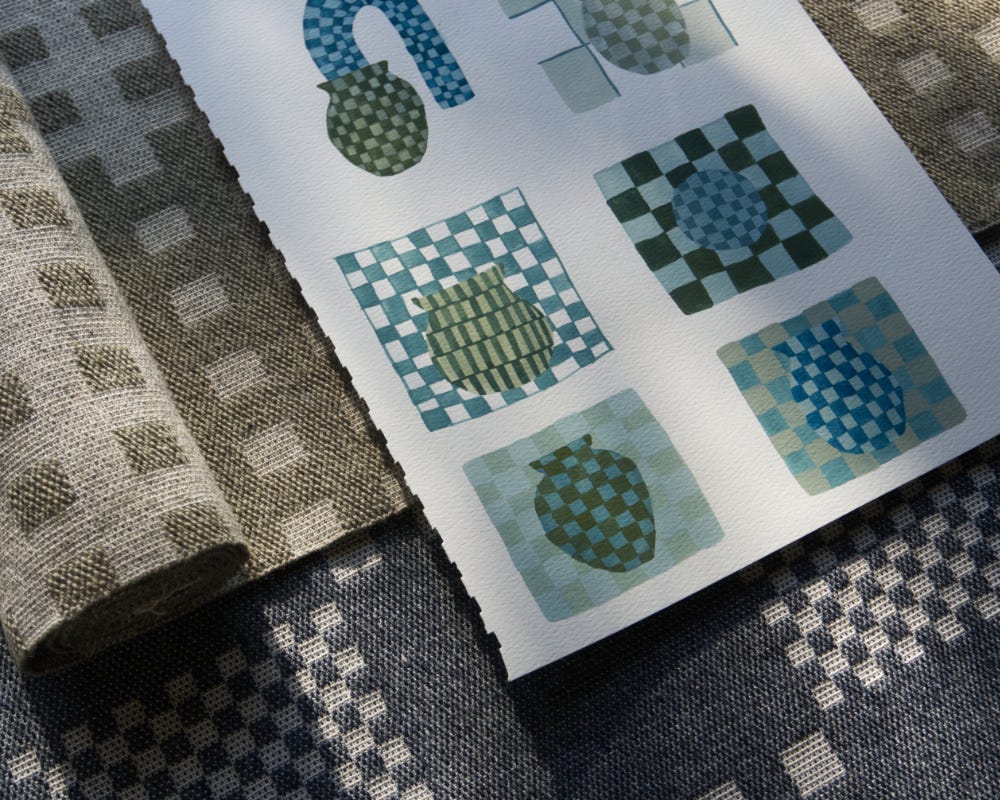
Soft Curve, Hard Line is in the window of Souk and Silk at 789 Dundas St. West, Toronto, from January 23-February 1, 2026.
Helen and I have also been invited as panelists for a conversation called Within the Weave, happening on Sunday February 1st from 2-3pm at the Collective Arts Taproom, 777 Dundas St West, Lower Level (very conveniently located right next to our exhibition!). Hope to see you there!
Weaving (Sticks)
Like many professional craft artists, my hobbies tend to be… work adjacent. One such pursuit is basketry. Many years ago I wove a random weave basket with foraged weeping willow, soaking the branches in my bathtub and making it up as I went along. Several years later, a friend taught me how to properly weave with real basketry willow, and I’ve made a basket or two most years since. I’m not very good and it can be physically challenging for my hands, but the process of creating a 3d form from a bundle of sticks is rewarding. It’s both familiar and so wildly dissimilar from what I do on the loom that there’s no mistaking that weaving, in this context, is a different thing entirely.
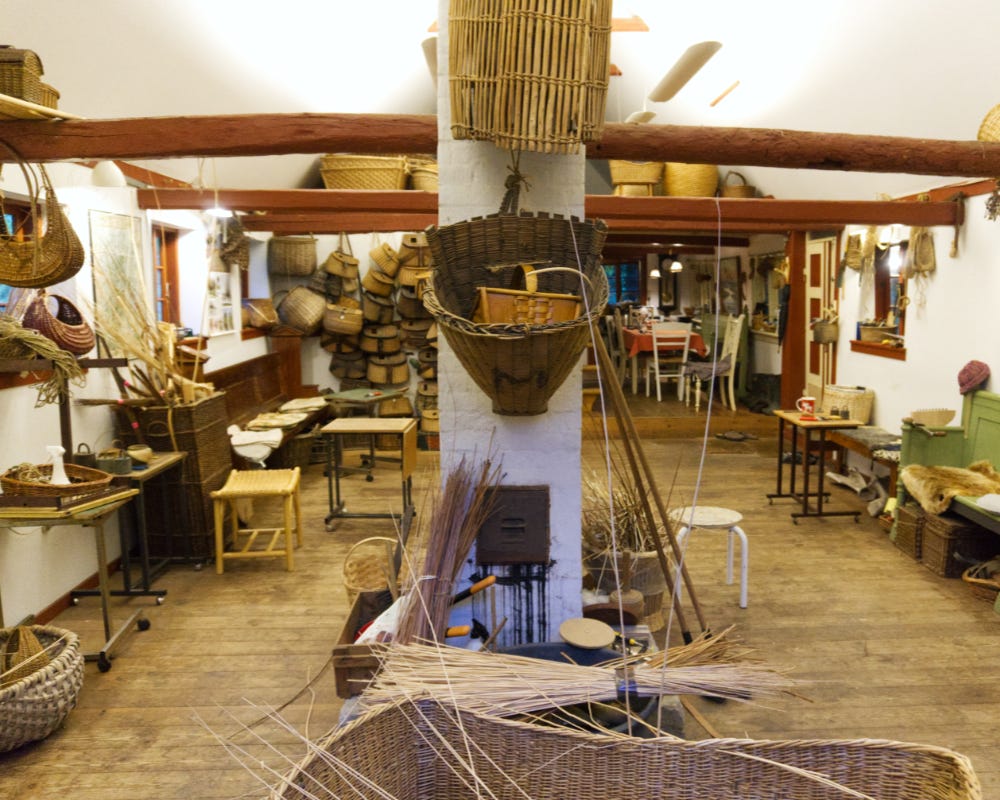
When I shared my plans to head to Denmark, my basketry friends were very generous in sharing tips on weavers and teachers, connecting me with Steen H Madsen.
I arrived at Steen’s thatched roof studio, Hilda’s Hus, in the middle of the Sjælland countryside during a rainstorm, damp from trying to out-ride the clouds, to a studio redolent with woodsmoke and the distinct scent of willow.
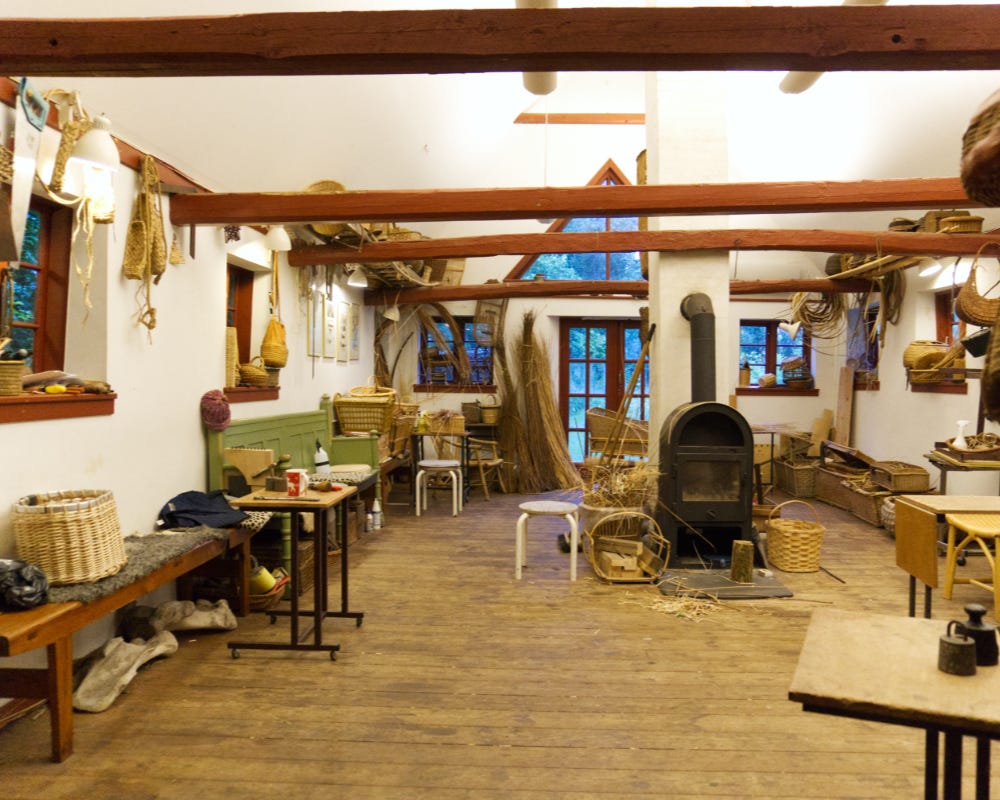
As I dried up and looked around the basket-filled studio, we were joined by some of his friends bearing (hand made) baskets full of food and sat down for coffee, tea, and what I would call brötchen and I’m sure the Danes call something else (perhaps rundstykker?) — bread rolls with cheese and jam and other yummy things. After that, it was time to get to work!
It’s been at least a year, maybe more, since I last wove a basket, so I was a bit out of practice. I knew the vague size and shape of basket I wished to make, and let Steen guide me as if I was a complete novice — thankfully, my hands remembered the basics of what to do!
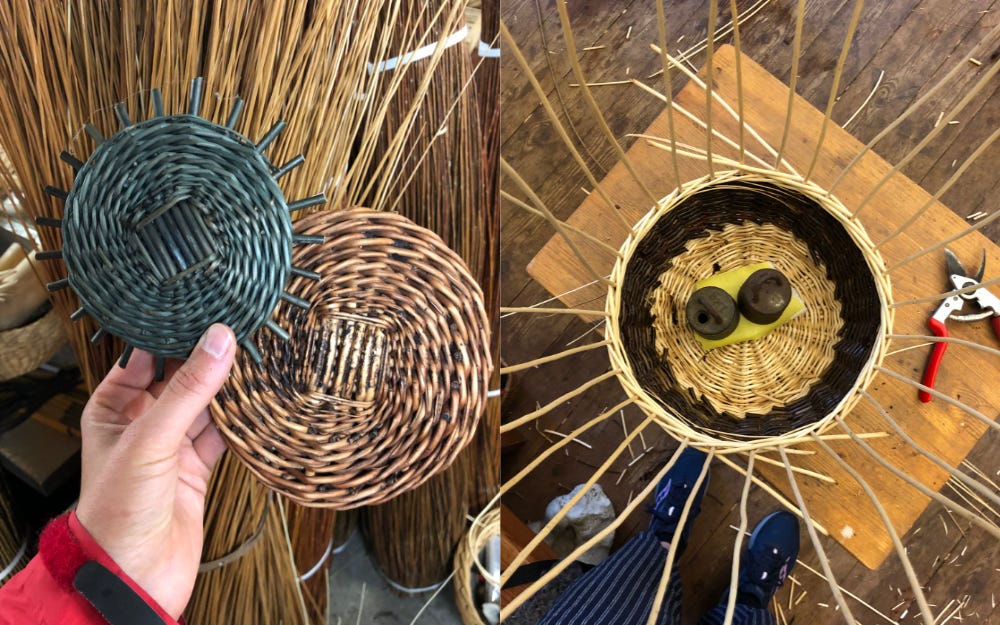
When a basket is built using a radiating base it is called stake and strand basketry, and it is the predominant technique used for willow or cane basketry in the European tradition. Working from the base, the stakes (which, for loom weavers, are the warp) are interlaced with weavers (“strands”; or weft) to build up the shape.
Basketry willow is a fascinating material and very different than garden or wild willow. It’s believed that humans have been making baskets for 10-12,000 years, and these millennia of cultivation has given us many different varieties tuned for different attributes: tall, short, flexible, stiff, and everything in between. Traditional basket crafts like, for example, caskets or withy pot making, would use a variety specially suited to withstand both the making and intended use. (Please see references and resources at the bottom of this post for more on withy pots especially — I find them so interesting.)
And then there’s the colour, too! Basketry willow is cultivated for colour just as much as its physical characteristics. Every time I’ve made a new basket, I’ve gotten to know a new-to-me variety, many who have evocative names like Acutifolia, Green Edna, Bleu, or Rubykins. In Spring of 2025 I planted ten plants of the variety Salix purpurea ‘Packing Twine’ in my front yard; it creates long and slender medium green rods with a slight rosiness.
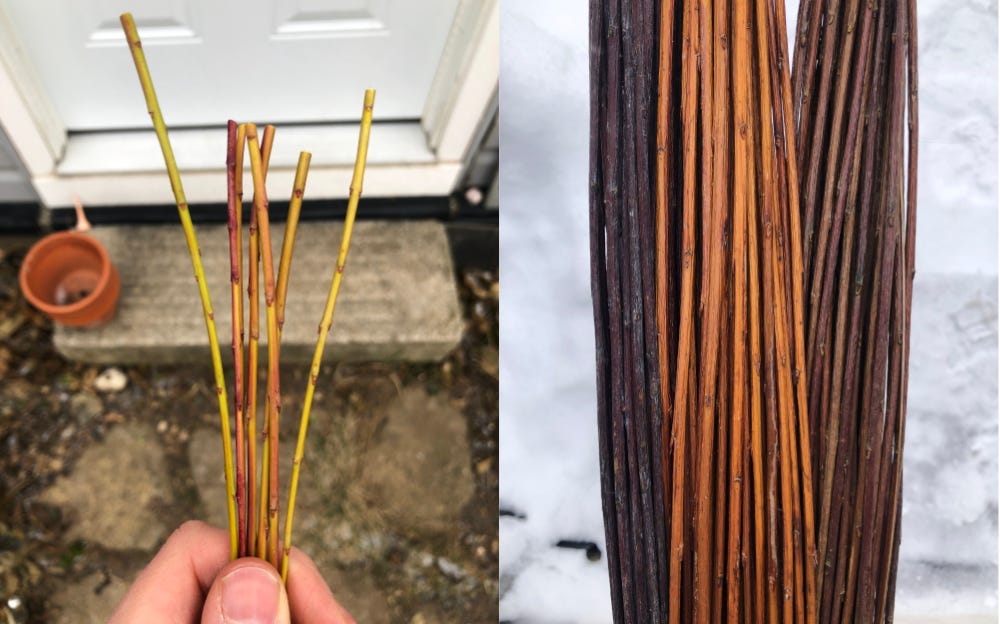
At home, I’ve made more baskets with colourful bark than without, but Steen shared that it was his preference to use the barkless willow. These rods have had the bark removed through various processes, resulting in a smooth rod. Buff willow refers to barkless rods that have been boiled or steamed before the bark is removed, which gives a golden, brown, or even black colour from the natural chemicals in the bark.
Whether you weave with bark on or off is mainly, these days, an aesthetic choice, but it does have some benefits, especially in a workshop context. To get willow bendy enough to be shaped into a basket, it needs to soak, usually for several days, depending on how long and thick the rods are. Peeled willow has a much shorter soaking time and therefore dries quicker too, which can help prevent your finished basket from getting mouldy. Peeled willow is also more pliable and soft, which is especially obliging for out-of-practice hands (like mine).
Our baskets grew in good company, with neighbour Pil and friend Pia joining us on the first day. Steen and Pia are building a database of European artworks and paintings that depict basketry to better understand the where, why, and when basket forms were used and originated. Much like textiles, baskets are so expected and commonplace in historic artwork that they are next to invisible, but once you know to look, they pop up in all sorts of paintings, prints, and even sculptures. If you work at a museum or gallery, Steen and Pia would love to know about the baskets that appear in the works in your collection (especially if you can provide an image for their research purposes).
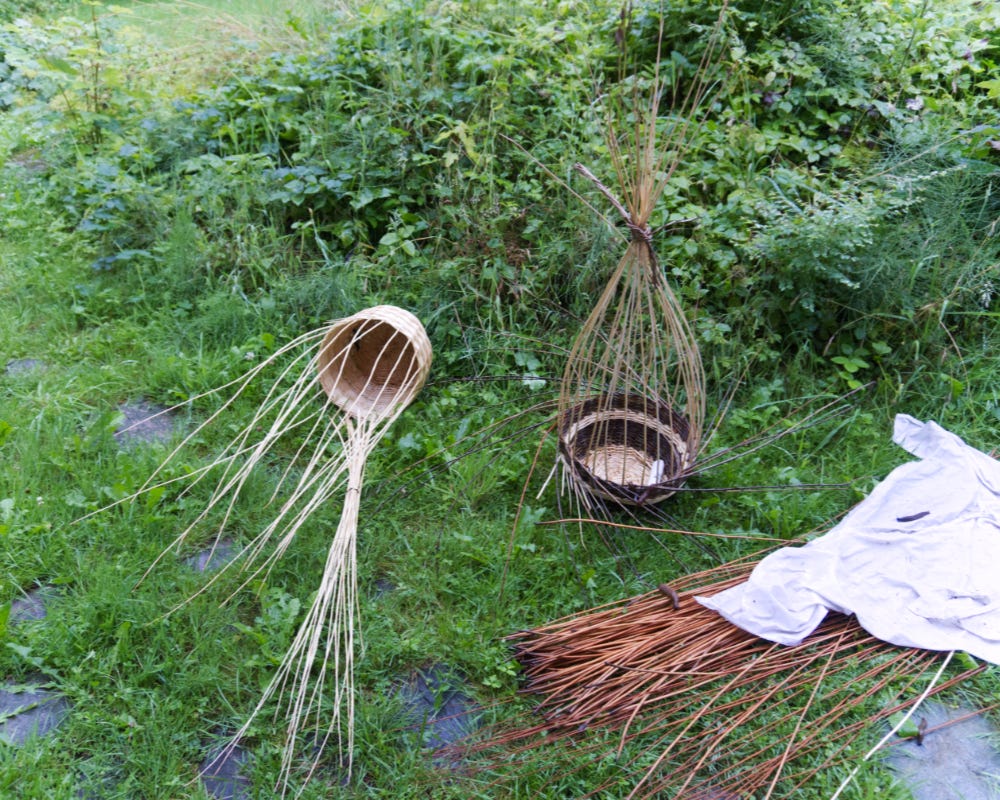
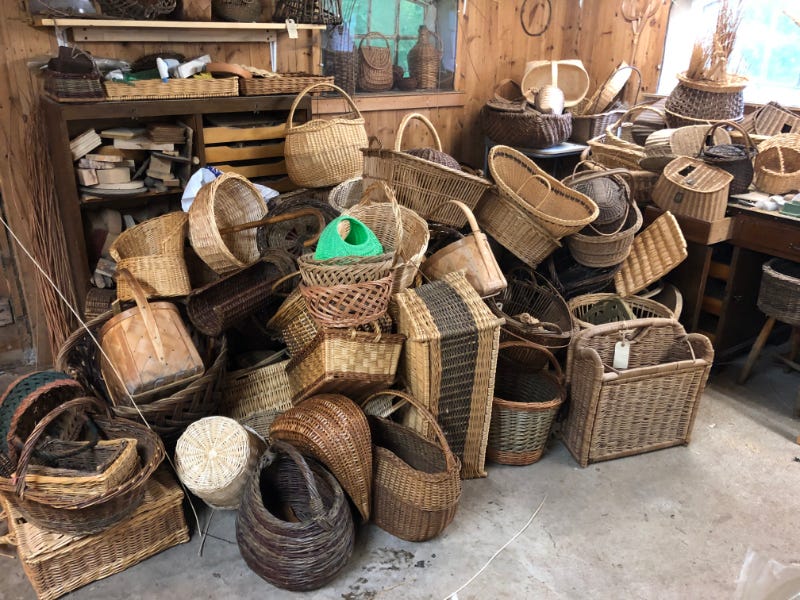
After a long day of weaving, our baskets went out into the damp grass outside the studio doors, and Steen and I had dinner together back at his house, which was, like the studio, covered in sticks and baskets. Steen’s long life of learning, making, and collecting was very evident through the many, many, MANY baskets collected from all over the world, made from materials like birch roots, wood, and even plastic — incidentally, the growth of the plastics industry in the 1950’s is why so many willow industries died, as the traditional craft and use of willow baskets was replaced by this less expensive and labour-intensive material. Of course, I would argue that the real cost plastic is extraordinarily and unsustainably expensive, since it contaminates our food and water supply, creates climate-damaging emissions, microplastics, and won’t biodegrade as willow does, but that’s perhaps a different article…
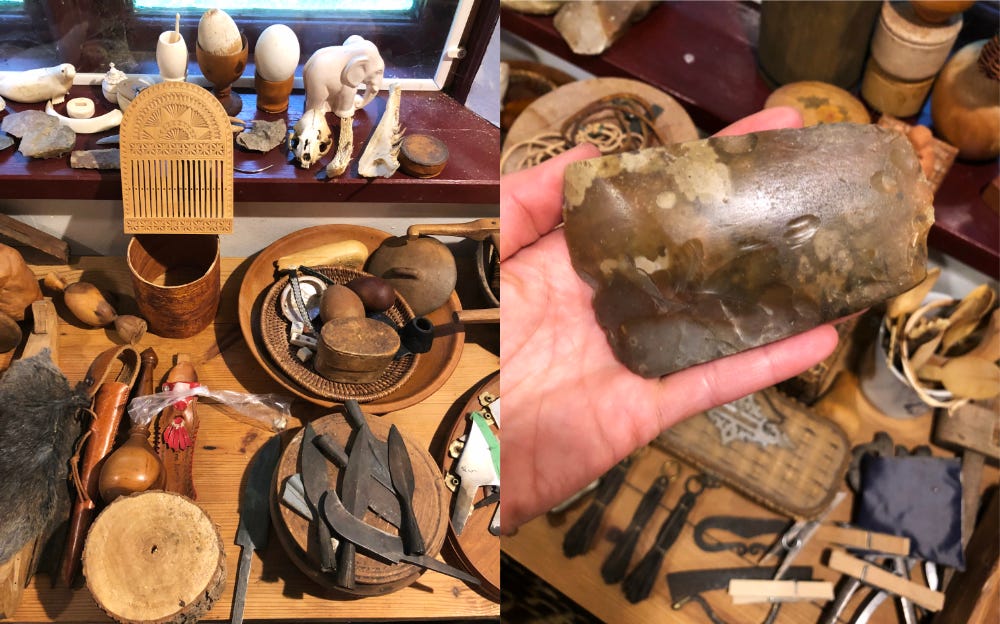
Along his windows were many small treasures, like a Sami carved spoon, replica iron spearheads, and a bronze age axehead he found in a field as a child (!). I was very tired by this point and my brain was overloaded by remembering and learning new weaving techniques, and meeting new people, but I would have liked to hear the story behind each object in his collection. Steen’s interest in history, tools, and making goes back to his youth, where he learned flint knapping at a archaeological research centre in Lejre. He told me that he had originally thought to be an archaeologist, but that in practice there was too much reading and not enough digging!
On day two, we got back to weaving after fortifying with more buns. My basket, by this point, had gone through two rounds of French randing, where there’s a weaver (weft) in between each stake (warp) and you weave around in a circle, manipulating each rod so they go in front and then behind a stake, like the under and over of plain weave. In this section, I used a bark-on willow.
In between the areas of French randing there is 4/1 waling, which adds stability to the basket’s shape. Waling is a slightly different technique in which two groups of weavers (in this instance, four on each hemisphere of the basket) “chase” each other around the basket, going over two and behind one stake. The waling in my basket is easy to see because it’s peeled willow.
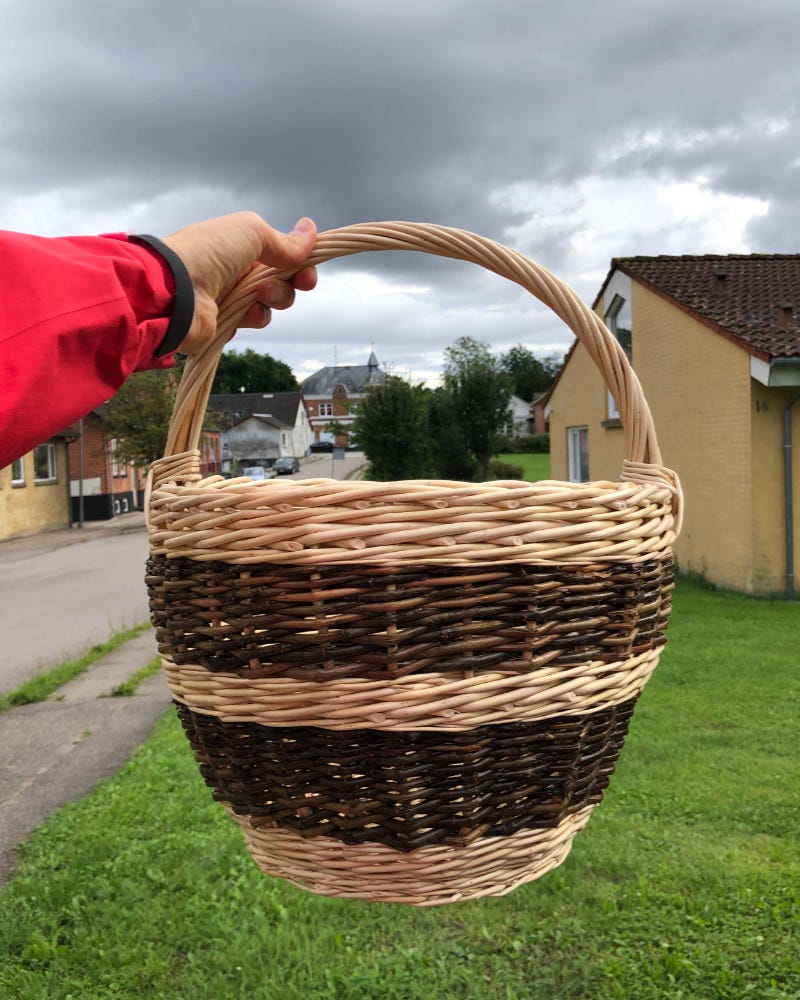
At the very top there is another round of waling and then you weave a border using what’s left of the stakes, which get gently folded and threaded behind and around each other. Lastly, I added a handle and a foot (which keeps the base of your basket off the ground), both techniques that were new for me.
Another neighbour, Signe, and her son had joined us that day, and after the weaving was complete, Signe generously took us to visit her farm down the road. Bjerregaarden is a 30 year old organic apple orchard, producing cider from over 50 different apple varieties.
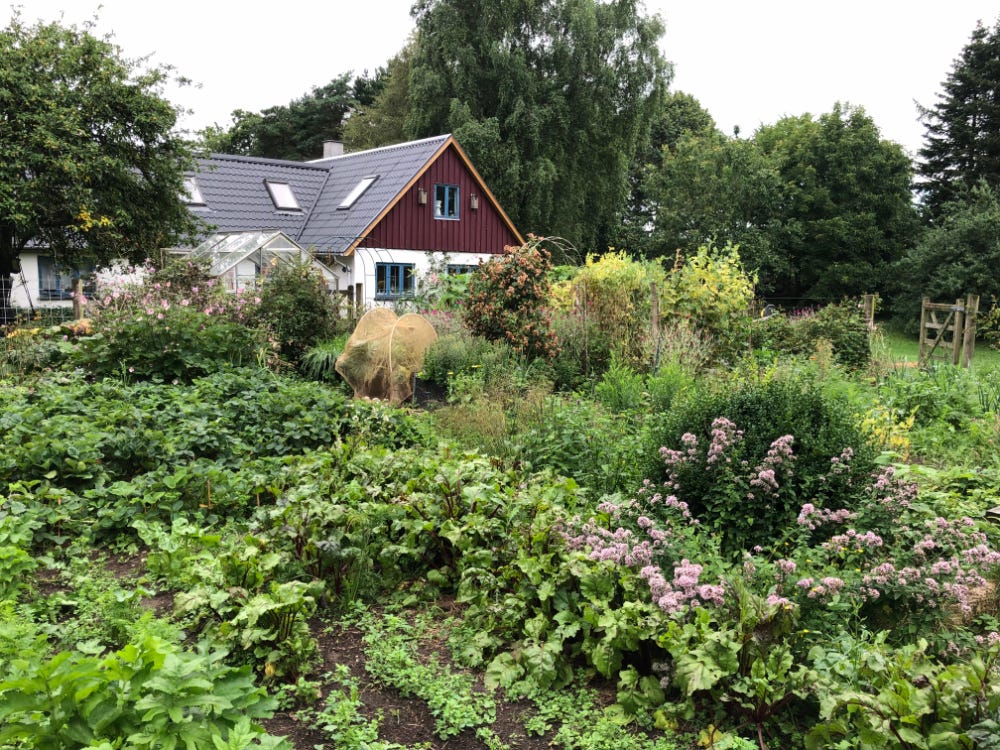
Signe took us on a tour through her vegetable garden and orchard, telling Steen and I about their process of making sparking cider and sparkling rhubarb cider, caring for trees, farming organically, and the history of the farm. You may enjoy watching this short video (in Danish) from TV2Øst where you can see more of the farm and hear Signe speak.
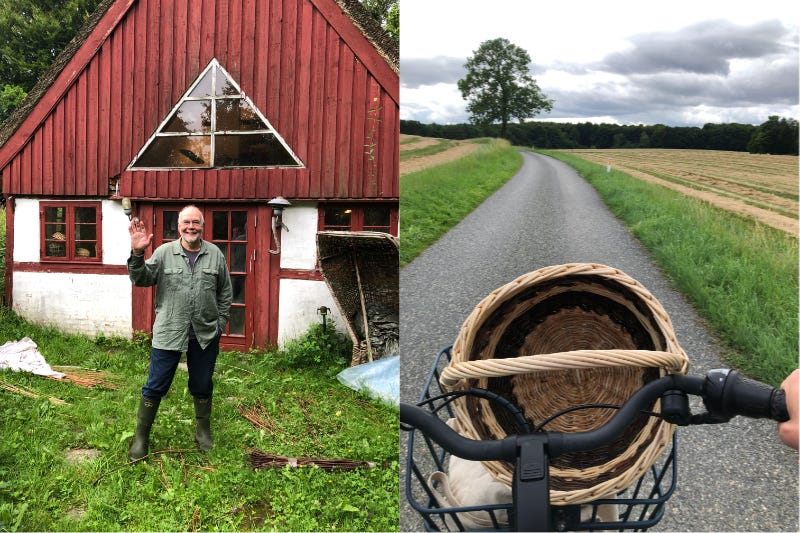
Visit and basket finished, I waved goodbye to Steen, hopped back on my bike, and took a winding countryside route up to a nearby town to catch the bus back to Nykøbing. I had an incredible visit with the generous Steen, and friends Pia, Pil, Signe and her son, and I think about them every time I use my basket.
In each newsletter I feel like I could say “this was the best part of my trip,” or “I learned so much,” and it’s always true — while it was only two days, this interlude felt particularly expansive because of everything new I learned with my hands and head. Many, many thanks to Steen for hosting me! He teaches regularly across Scandinavia and occasionally overseas — he’s got many 2026 courses planned already, which you can see on his workshop page.
If you’re in Ontario, consider taking a class with Johnny Suderman/Lakeshore Willows — you can also buy willow and cuttings from him too.
Ovnhus
In my last weekend in Nykøbing, a craft show came to town: OvnHus. This three-day market takes place annually on the 4th weekend in July and hosts around 75 professionals working in ceramics, textiles, glass, and more. Nykøbing is only an hour and a half or so from Copenhagen by train (less if you drive), and so it’s a wonderful opportunity for locals, city folk, and tourists to visit this small town and support Danish craft.
Two makers I enjoyed at OvnHus were Lærke Møller Hansen, and Birgit Daa Birkkjær.
Lærke works under the name Danish Clay Design, and I had passing familiarity with her work through the Toast New Makers program. Working in stoneware, Lærke creates earthy, sturdy functional tableware, developing glazes using locally sourced materials like wood ash and sand near her studio in a former blacksmith’s workshop near Odense, Denmark.
Birgit also makes vessels, using paper, linen, horsehair and wood, crafting delicate woven and twined baskets and sculptures. I particularly liked the strands of hanging baskets, that twirled and shook in the breeze from the edge of her tent. Some of the sculptural pieces combined small baskets with foraged wood from near her home. Her work was quiet and beautiful, with a wonderful material personality.
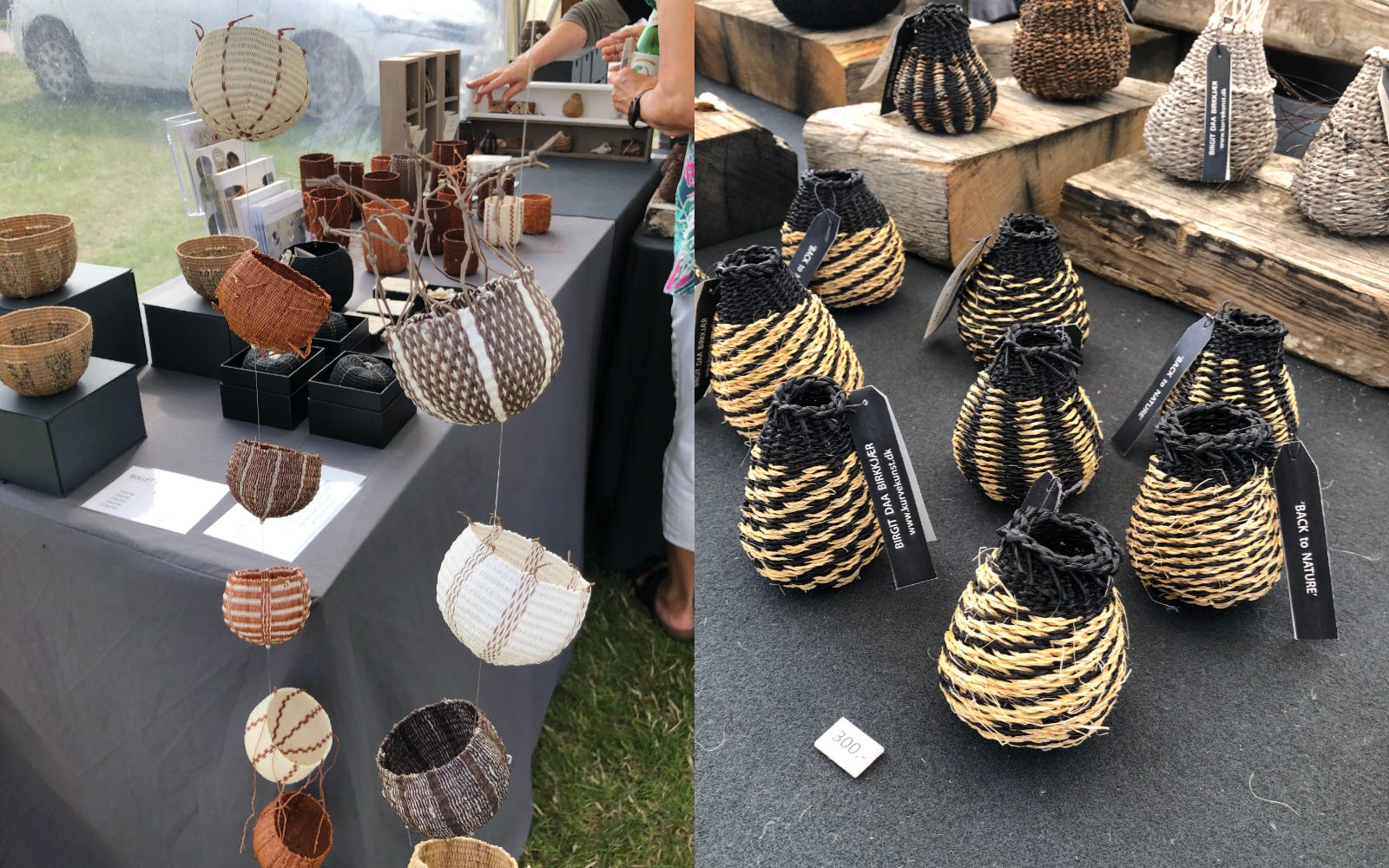
I didn’t take many pictures at OvnHus because it was a busy and exciting weekend — we hosted a small exhibition at Det Vilde Spinderi on the Saturday and had many visitors too — but I’ll share more about it, and what I and my co-residents made, next month.

I would like gratefully acknowledge the support of the Canada Council for the Arts for my residency at Det Vilde Spinderi.
References & Further Reading
For more on withy pots, I recommend these two videos available on Youtube:
- Less than 10 traditional willow lobster pot makers remain.
- Weaving Lobster Pots.
“Basket Making.” Heritage Crafts UK. https://heritagecrafts.org.uk/craft/basket-making/ January 11, 2026.
“Threads 90: The Wonderful World of Willow - The History and Traditions of Willow.” Lanark Highlands Basketry Museum. https://www.lanarkhighlandsbasketrymuseum.ca/blog/threads-90-the-wonderful-world-of-willow-the-history-and-traditions-of-willow January 11, 2026.
“Toast of the Town” World of Interiors. https://www.worldofinteriors.com/story/toast-new-makers-2025 January 11, 2026.
Wright, Dorothy. The Complete Book of Basketry. Dover Publications Inc, 1992.